
Uncategorized

Deportation sans law: Compensation in cases of forced expulsion – Part 3

Third part of the five-part series examining the forcible expulsion of Indian citizens to Bangladesh based on unverified suspicions of illegal migration, conducted without due process
Deportation sans law: Compensation in cases of forced expulsion – Part 3

South Asia Human Rights Documentation Centre

Published on: 

11 Feb 2026, 9:12 pm

Follow Us

Forced expulsion is not merely a procedural error in the deportation framework but an aggravated form of unlawful custody. Whereas wrongful detention cases ordinarily end with release, pushbacks combine deprivation of liberty with the risk of statelessness, family separation, and displacement across an international border. Victims frequently lose access to homes, livelihoods, medical care and community support structures. In Bangladesh, expelled individuals may face criminalisation as irregular entrants, creating harms that extend well beyond the moment of expulsion. These cumulative harms sharpen the constitutional injury under Article 21 and strengthen the argument that forced expulsion demands a heightened remedial response.

Legal research tools

The constitutional framework analysed earlier establishes a clear principle: where the State causes unlawful detention or deprivation of liberty, compensation under Articles 21, 32 and 226 is available as a public law remedy. This principle does not depend on the geographical site where the unlawful detention ends. Forced expulsion, particularly when preceded by warrantless detention, denial of judicial scrutiny and summary removal across an international border, constitutes an aggravated form of unlawful custody and an actionable constitutional wrong.

The pattern of forcible expulsions documented in border districts of West Bengal and Assam therefore raises not only citizenship disputes but urgent remedial questions: whether victims of detention and expulsion are entitled to compensation, which harms are compensable, and how such victims can realistically access remedies given their removal from Indian territory and their socio-economic marginalisation.

Forced expulsion, particularly when preceded by warrantless detention, denial of judicial scrutiny and summary removal across an international border, constitutes an aggravated form of unlawful custody and an actionable constitutional wrong.

Forced expulsion as continuing illegal custody

In the Supreme Court’s compensation jurisprudence, the trigger for public law liability is not the length of custody but the absence of lawful authority, the denial of due process and the infringement of dignity and liberty under Article 21. In numerous border expulsions, individuals are detained without statutory basis, deprived of the right to know the grounds of custody, denied access to counsel or judicial oversight and removed across borders without adjudication.

Such expulsions constitute an extension of illegal custody where the deprivation of liberty does not cease at the point of removal but is aggravated by statelessness risk, separation from family, loss of livelihood and exposure to criminalisation in the receiving country. Under Rudul Sah v. State of Bihar (1983), Nilabati Behera v. State of Orissa (1993) and contemporary High Court practice, each of these harms is cognisable as part of the constitutional injury.

Forced expulsion also produces a broader class of harms than traditional wrongful detention cases. These include statelessness or uncertain nationality status; long-term stigma and social ostracisation; deprivation of medical care, particularly acute for children, elderly persons, and pregnant women; economic displacement and loss of residence; and psychological trauma linked to sudden displacement. These consequences demonstrate why illegal detention culminating in expulsion is an aggravated constitutional wrong rather than a mere procedural lapse.

Why relief is unlikely in practice

Despite clear constitutional principles and doctrinal foundations for compensation, victims of forced expulsion are structurally unable to access remedies. Practical obstacles render compensation almost unattainable.

Victims are physically removed from Indian territory, making writ jurisdiction under Articles 32 and 226 practically inaccessible. In the absence of a statutory compensation regime, victims must rely on judicial discretion rather than clear legal entitlements. India’s reservation to Article 9(5) of the International Covenant on Civil and Political Rights further weakens external accountability mechanisms that might otherwise strengthen domestic remedies.

Through a line of landmark cases, the Supreme Court and High Courts have recognised a right to compensation for unlawful arrest, detention and custodial abuse as an integral component of Article 21.

Those targeted for expulsion are overwhelmingly poor, Bengali-speaking, Muslim, Rohingya, or Adivasi populations with limited access to legal representation. Border Security Force operations are often shielded from scrutiny, and deportation procedures lack transparency. Tribunal orders, bail conditions and appellate processes are routinely disregarded in favour of executive pushbacks. Complaints to human rights institutions rarely result in effective relief. Thus, although constitutional jurisprudence strongly supports an entitlement to compensation, prevailing structural conditions render the remedy largely theoretical.

Towards a statutory compensation framework

To convert constitutional doctrine into enforceable remedies, victims of forced expulsion require a statutory framework that recognises illegal detention and forced expulsion as compensable harms, provides clear criteria for quantification, including enhanced awards for vulnerable groups such as pregnant women, children, elderly persons, and those rendered stateless, establishes an independent body empowered to investigate pushback incidents and award compensation, permits applications from abroad or through legal aid, NGOs, or remote representation, and integrates compensation with accountability mechanisms, including recovery from responsible officials.

A statutory scheme would align India’s remedial architecture with global practice. Comparative jurisdictions such as Spain, the United Kingdom, the United States, Germany, and New Zealand recognise compensation for wrongful detention not merely as a discretionary gesture but as a structural guarantee against State abuse of coercive power. In the Indian context, such a framework would ensure that victims of detention and expulsion are not relegated to a legal no-man’s land – deprived of liberty, displaced from their homes, and denied the remedies the Constitution already promises.

What can be done

Constitutional law books

India’s constitutional jurisprudence has travelled far from the position reflected in its reservation to ICCPR Article 9(5). Through a line of landmark cases, the Supreme Court and High Courts have recognised a right to compensation for unlawful arrest, detention and custodial abuse as an integral component of Article 21. Contemporary High Court decisions, including those of the Kerala and Patna High Courts, demonstrate that this right continues to be actively enforced in cases of wrongful imprisonment and unlawful detention of juveniles.

Yet this remedial architecture largely bypasses those at the country’s borders. For Indian citizens and citizenship-contested populations summarily detained and forcibly expelled to Bangladesh or Myanmar, the constitutional promise of liberty and remedy is effectively annulled. Because victims are removed from Indian territory, live in conditions of extreme precarity, lack documentation and legal assistance and confront powerful border-policing institutions, they rarely reach the Supreme Court or High Courts. The result is a systemic remedial deficit precisely where violations are most severe.

To make the right to compensation meaningful, India requires a comprehensive statutory framework that transforms fragmented judicial doctrine into an accessible, uniform and enforceable scheme.

Forced expulsion must be recognised for what it is: an aggravated form of arbitrary detention and a grave constitutional wrong. If the State is strictly liable for a few days of unlawful custody within India, it cannot be absolved of responsibility when its agents unlawfully seize a person, deny due process, and abandon them in another country. The logic of Rudul SahNilabati Behera and subsequent High Court practice leads inexorably to the conclusion that victims of forced expulsion are entitled to compensation. Unlike deportation regimes in the European Union, where expulsion follows an individualised assessment, written reasons and appellate safeguards, pushbacks in eastern India often occur without any determination of nationality, lawful authority or procedural protections.

To make the right to compensation meaningful, India requires a comprehensive statutory framework that transforms fragmented judicial doctrine into an accessible, uniform and enforceable scheme. Compensation must not depend on litigation capacity or happenstance, but operate as a predictable constitutional guarantee. Until such a framework is established, victims of border expulsions will continue to inhabit a legal no-man’s land – deprived of liberty, displaced from their homes and denied the remedies that the Constitution, in principle, already promises.

This is Part 3 of a five-part series. Part 4 will examine domestic and international law on compensation.

Uncategorized

Deportation sans law: Collective expulsion and non-refoulement – Part 2

Deportation sans law: Collective expulsion and non-refoulement – Part 2
Second part of the five-part series examining the forcible expulsion of Indian citizens to Bangladesh based on unverified suspicions of illegal migration, conducted without due process
Deportation sans law: Collective expulsion and non-refoulement – Part 2
South Asia Human Rights Documentation Centre
Published on:
07 Feb 2026, 6:47 pm

Follow Us

AT LEAST 300 of those expelled are from the state of Assam, which, in 2019, underwent a contentious citizenship verification process that was arbitrary, flawed and excluded nearly two million people. Law practice management

Expulsion and non-refoulement

The Citizenship Act, 1955 and associated rules provide that official documents such as land records and electoral rolls may be relevant in establishing citizenship. Determination of foreigner status lies with civil courts, foreigners tribunals, and duly constituted administrative authorities under the Foreigners Act, 1946 and related legislation.

Border Security Force (BSF) has no statutory competence to unilaterally declare someone a foreigner or to expel them from Indian territory. When BSF summarily removes individuals across borders, it bypasses institutions designed to adjudicate citizenship disputes.

The Constitution of India contains provisions on the status of international law in India under the Directive Principles of State Policy enshrined in Part IV of the Constitution which provide that the state shall endeavor to foster respect for international law and treaty obligations in the dealings of organized people with one another. It is well established in India that the principle of customary international law can be enforced by the courts if they are not in conflict with the statutes.
The United Nations Office of the High Commissioner for Human Rights reported that the authorities forced 40 Rohingya refugees into the sea near Myanmar, giving them life jackets and making them swim to shore.

While India is not a party to the 1951 Refugee Convention, general principles of non-refoulement and the prohibition on collective expulsion are recognized in customary international law and international human rights instruments. The European Court of Human Rights has held in Hirsi Jamaa and Others v. Italy (2012) that Italy violated the prohibition on collective expulsion and non-refoulement by intercepting migrants at sea and returning them to Libya without individualized assessment or remedy. In Čonka v Belgium (2002), the Court found that the summary expulsion of a Roma family without effective remedy violated Article 5 (liberty), Article 13 (effective remedy) and Article 4 of Protocol No. 4. Pushing individuals, including pregnant women, into foreign territory without status determination violates these principles and exposes victims to destitution, criminalization in the receiving country, and risk to life. Constitutional law books

Indian authorities have expelled about 100 Rohingya refugees from a detention center in Assam across the Bangladesh border. The United Nations Office of the High Commissioner for Human Rights (OHCHR) reported that the authorities forced another 40 Rohingya refugees into the sea near Myanmar, giving them life jackets and making them swim to shore in what the UN special rapporteur on Myanmar, Tom Andrews, called “an affront to human decency.” Others cite higher figures. Law practice management

India is obligated under the International Covenant on Civil and Political Rights (ICCPR) and the International Convention on the Elimination of All Forms of Racial Discrimination (ICERD) to ensure the protection of everyone’s rights and to prevent deprivation of citizenship on the basis of race, color, descent, or national or ethnic origin.
Deportation sans law: Collective expulsion and non-refoulement – Part 2
Deportation sans law: Indian citizens forcibly expelled to Bangladesh – Part 1

According to Human Rights Watch, India’s detention and expulsion of anyone without due process violates fundamental human rights. The Indian government should ensure access to fundamental procedural safeguards for anyone subject to expulsion. This includes access to full information about the grounds for deportation, competent legal representation, and an opportunity to appeal a decision to expel.

An estimated 40,000 Rohingya live in India, at least 20,000 of whom are registered with the UN refugee agency. Although India is not a party to the 1951 UN Refugee Convention or its 1967 Protocol, India is bound by the customary international law principle of non-refoulement, which prohibits countries from returning or expelling people to places where they face threats to their lives or freedom.

Collective expulsion and customary international law

The incidents described exhibit elements of collective expulsion as understood in international human rights law: removal without individualized assessment, absence of remedy, and lack of procedural guarantees. The earlier mentioned jurisprudence of the European Court of Human Rights (such as in Hirsi Jamaa and Čonka) confirms that collective expulsion violates both the prohibition on arbitrary detention and the right to effective remedy, principles recognized in customary international law and binding on India notwithstanding its non-party status to the Refugee Convention.

Statelessness

Pushbacks often strand individuals in Bangladesh without recognized nationality or documentation. Where Bangladesh refuses to accept expelled persons, families may become divided across borders and long-term uncertainty regarding nationality and return becomes inevitable. Statelessness is a recognized aggravating harm under international law, and its risk is heightened in regions where citizenship documentation has historically been contested. Law practice management
Global remedial frameworks reinforce the view that unlawful detention and deprivation of liberty must be paired with effective remedies, including compensation.

Humanitarian harms

Pushbacks produce humanitarian consequences beyond the deprivation of liberty. Victims report loss of shelter, food insecurity, medical neglect, and exposure to criminalization as irregular entrants in Bangladesh. Elderly persons, children, and pregnant women face heightened risks, and the sudden displacement fractures family units and economic livelihoods. The International Committee of the Red Cross (ICRC) has underscored that deprivation of liberty entails obligations concerning humane treatment, health, and family contact; pushbacks ignore all three.

Recent Supreme Court jurisprudence

In a recent judgment reported by The Hindu, the Supreme Court held that the State is constitutionally prohibited from initiating or continuing criminal proceedings when there is no reasonable prospect of securing a conviction, as this would amount to an abuse of the criminal process and a violation of Articles 14 and 21. The Court emphasized that State power must be exercised with ‘constitutional responsibility’ and ‘evidentiary discipline’, and that baseless or speculative allegations cannot justify the restraints placed on an individual’s liberty.

This principle directly strengthens the conclusion that forcible expulsion, carried out without evidence, legal authority, or any lawful procedure, constitutes an arbitrary deprivation of liberty. If the State cannot prosecute a citizen without reasonable grounds, it certainly cannot detain or expel a citizen in the complete absence of legal basis. The BSF’s actions therefore exceed not only statutory limits but also the constitutional threshold established by the Supreme Court for any State interference with personal liberty.
Deportation sans law: Collective expulsion and non-refoulement – Part 2
The Rohingya question before the Supreme Court of India

Soft law and comparative remedial standards Law practice management

Global remedial frameworks reinforce the view that unlawful detention and deprivation of liberty must be paired with effective remedies, including compensation. The UN’s Basic Principles and Guidelines on the Right to a Remedy and Reparation (2005) recognize restitution, rehabilitation, satisfaction, and compensation as integral components of redress for unlawful detention.

The UN Working Group on Arbitrary Detention has consistently held in its opinions that compensation is not discretionary but a necessary remedial consequence of arbitrary detention. Regional human rights systems, including the European Court of Human Rights (see Article 5(5) ECHR) and the Inter-American Court of Human Rights (as in Yean and Bosico v. Dominican Republic (2005) and Bámaca Velásquez v Guatemala (2000 and 2001)), have developed compensation jurisprudence due to the right to liberty and non-discrimination.

In addition, instruments under the International Convention on the Elimination of All Forms of Racial Discrimination obligate States to provide effective remedies for discriminatory deprivation of nationality or expulsion (see Article 5(d)(iii) and Article 5(d)(ii)). Comparative common law jurisdictions (such as UK Criminal Justice Act, 1988, s. 133) provide statutory or judicially administered compensation for wrongful conviction and detention, which shows that arbitrary deprivation of liberty engages not only constitutional accountability but remedial obligations.

This is Part 2 of a five-part series. Part 3 will examine compensation in cases of forced expulsion.

Human Rights Features

Deportation sans law: Indian citizens forcibly expelled to Bangladesh – Part 1

Deportation sans law: Indian citizens forcibly expelled to Bangladesh – Part 1
First part of the five-part series examining the forcible expulsion of Indian citizens to Bangladesh based on unverified suspicions of illegal migration, conducted without due process
Deportation sans law: Indian citizens forcibly expelled to Bangladesh – Part 1
South Asia Human Rights Documentation Centre
Published on:
03 Feb 2026, 1

BORDER detentions and forcible expulsions, commonly referred to as “pushbacks,” are not isolated incidents but form part of a systematic pattern across Eastern India. Reports from Assam, West Bengal, and adjoining border districts document pushbacks occurring at multiple crossing points, including Barpeta, Karimganj, Cooch Behar, Malda, Nadia, and Dhubri.Law practice management

These border areas have long-standing demographic, linguistic and familial ties with communities across the border in Bangladesh. The populations targeted for expulsion are overwhelmingly drawn from poor, Bengali-speaking Muslim and Adivasi communities who face structural disadvantages, limited access to legal representation, and low levels of documentary literacy.

A critical legal anomaly compounds the problem with the Border Security Force (BSF), the primary agency conducting these pushbacks, has no statutory authority to determine citizenship or nationality status. Under Indian law, citizenship determination falls exclusively within the jurisdiction of civil authorities, Foreigners Tribunals, and appellate bodies established under the Foreigners Act, 1946. The absence of due process, judicial oversight, and nationality verification prior to expulsion transforms what should be a legal determination into an arbitrary executive action by a border force operating outside its lawful mandate.

Recent reporting by The Indian Express in January 2026 documented additional cases in which families from Odisha and West Bengal were subjected to summary expulsion despite possessing land records and multiple forms of citizenship-linked documentation. In several instances, Bangladeshi authorities declined to accept the expelled individuals, citing lack of verification or mismatched paperwork, leaving them stranded across the border. These cases illuminate the complex cross-border family networks that characterize the region, the administrative uncertainty surrounding expulsions and the severe humanitarian consequences of a pushback regime operating without procedural safeguards.

Forcible expulsion of a pregnant woman

In September 2025, Scroll.in reported the case of a pregnant woman from West Bengal who was forcibly taken across the border into Bangladesh by BSF personnel on suspicion that she was an “illegal Bangladeshi migrant.” Her family, who had lived in the region for at least five generations and possessed land records, ration cards, Aadhaar cards, and other documentation establishing Indian citizenship, stated that she had never resided in Bangladesh.

According to eyewitness accounts, BSF personnel entered the village, detained the woman without a warrant, and transported her, along with several others, across the international border in a truck. She was not presented before a magistrate, not informed of any grounds for arrest, and not given an opportunity to challenge the expulsion. Her family only discovered her whereabouts after relatives in Bangladesh located her; they were told by local authorities there that she had been “pushed back” by India.
Deportation sans law: Indian citizens forcibly expelled to Bangladesh – Part 1
The Rohingya question before the Supreme Court of India

The incident reflects a disturbing pattern in West Bengal and Assam border districts, where Indian citizens, often from poor, Muslim, Bengali-speaking or Adivasi communities, are labelled as “Bangladeshi infiltrators” and summarily expelled without due process. The woman’s pregnancy underscores both the gravity and inhumanity of such expulsions, which not only violate fundamental rights but render individuals effectively stateless, separated from their families and deprived of any legal recourse.Law practice management

Systemic pattern of arbitrary detention and expulsion

Reports from Assam reveal a broader pattern in which individuals, many of whom hold documentary proof of Indian citizenship or have received favourable orders from Foreigners Tribunals, are detained arbitrarily and expelled across the border without legal process.

In the Karbi Anglong district, police detained a 45-year-old man at night without providing grounds for his arrest. Although a Foreigners Tribunal had ruled in his favour in January 2024, a new ex parte order declaring him an irregular immigrant was issued without notice in April. His family was unable to ascertain his whereabouts and ultimately petitioned the Guwahati High Court.

In Barpeta district, a 67-year-old woman, Maleka Khatun, who had spent nearly six years in detention before being released on bail, was forcibly pushed into Bangladesh around 3:00 a.m. by BSF personnel despite her advanced age, impaired mobility and ongoing legal proceedings. She later managed to contact her family from a village in Kurigram district of northern Bangladesh after borrowing a phone. In the same district, authorities detained a 44-year-old man and expelled him to Bangladesh within 24 hours. His family later received a call from him after he had walked for three days to find shelter.

In both the latter cases, the individuals were the only members of their families declared irregular immigrants and both had appeals pending before the High Court.

Legal violations under Indian constitutional law

These incidents raise serious constitutional and legal violations under Indian law and international human rights standards. Forcible expulsion without lawful authority constitutes a direct infringement of Article 21 of the Constitution. The Supreme Court has repeatedly held that deprivation of liberty must follow “procedure established by law,” which includes transparency, non-arbitrariness, and judicial oversight as established in Maneka Gandhi v. Union of India (1978). None of these safeguards were observed in the documented cases.Law practice management

The individuals were neither arrested under a lawful provision nor informed of any grounds justifying their detention or expulsion. Their removal across an international border, without any legal process, amounts to an unconstitutional deprivation of liberty.

Article 22(1) and (2) provide that any person arrested must be informed of the grounds of arrest, and produced before a magistrate within 24 hours. Border expulsions of this nature routinely bypass judicial scrutiny altogether. BSF personnel do not possess the authority to determine citizenship or nationality; these determinations fall within the jurisdiction of civil authorities and tribunals constituted under the Foreigners Act, 1946. Expelling a person without even initiating such proceedings is unlawful.

In the documented cases, the victims’ families held multiple generations of land records and official identity documents. Under the Citizenship Act, 1955, these constitute prima facie evidence of Indian citizenship. The BSF has no statutory power to unilaterally declare an individual a foreigner or to remove them from Indian territory.Constitutional law books
Deportation sans law: Indian citizens forcibly expelled to Bangladesh – Part 1
Why India’s seventh entry into the UNHRC is a troubling tale for Indians and credibility of the UN human rights system

Such expulsions bypass every legal forum designed to adjudicate citizenship disputes: civil courts, Foreigners Tribunals, and appellate procedures. The State’s actions therefore amount to an executive usurpation of judicial authority.

The cases documented above demonstrate a systematic absence of due process. Individuals are detained without warrants, not informed of the grounds for detention, not produced before magistrates, and expelled across international borders without any opportunity to challenge the action. This complete circumvention of legal procedure renders the expulsions arbitrary and unconstitutional.

Violations of international human rights lawLaw practice management

Although India entered a reservation to Article 9(5) of the International Covenant on Civil and Political Rights (ICCPR), it remains bound by Article 9(1)-(4). The individuals documented in these cases were arbitrarily detained, deprived of their liberty, denied judicial review of their detention, and subjected to a procedure devoid of legal basis.

Even with India’s reservation, the complete absence of procedure places these incidents squarely within the category of prohibited arbitrary detention and expulsion under international law.

Indian authorities claim they are expelling people who entered India illegally from Bangladesh. While dozens of expelled individuals have indicated that they are Bangladeshi nationals, many others have insisted they are Indian citizens. The lack of due process has meant that Indian nationals, predominantly Bengali-speaking Muslims, have been unlawfully expelled.

Bangladeshi authorities have repeatedly stated that the Indian government’s unilateral actions violate established repatriation procedures. They have urged Indian authorities to follow transparent, verifiable processes to address these cases in line with international standards.

This is Part 1 of a five-part series. Part 2 will examine collective expulsion and non-refoulement principles.

Human Rights Features

The Umar Khalid and Sharjeel Imam case: An international campaign within the realm of possibility

India’s refusal to accept individual complaints under the ICCPR leaves political prisoners without international recourse, unless civil society chooses to act.

The Umar Khalid and Sharjeel Imam case: An international campaign within the realm of possibility

Ravi Nair

Published on:

07 Jan 2026, 6:19 pm

The recent decision of the Supreme Court of India barring Mr. Umar Khalid and Mr.  Sharjeel Imam, from applying for bail for a year, to put it mildly, is astounding. They have both been under-trials for over 5 years. Other commentators have called into question much of the reasoning of the Supreme Court in their rejection of the bail application. Their sound criticism does not bear repetition here.

This piece only seeks to underline both the apparent ignorance and pusillanimity of the political class, and most of civil society in not educating public opinion for the need and ability to access remedial international human rights mechanisms when domestic judicial or executive remedies are unequal to the task of undoing a wrong.

The unused architecture of international human rights remedies

Reference here is to the First Optional Protocol to the International Covenant on Civil and Political Rights (ICCPR) by ratification. India has been a party to the main ICCPR treaty since 1979, it is among the countries that differentiate the acceptance of substantive rights from the acceptance of international individual complaint mechanisms.

By not ratifying this protocol, India does not recognize the competence of the UN Human Rights Committee to receive and consider “communications” (complaints) from individuals within its jurisdiction who claim their rights under the ICCPR have been violated.

The First Optional Protocol establishes a mechanism allowing individuals to submit complaints to the UN Human Rights Committee if they claim their rights under the ICCPR have been violated by a state party.

In South Asia, the countries that have become a party to the First Optional Protocol to the International Covenant on Civil and Political Rights (ICCPR) by ratification or accession are Bangladesh, Maldives, and Sri Lanka. Bangladesh acceded to the Protocol, which entered into force for the country on December 6, 2000.Maldives acceded to the Protocol, which entered into force for the country on September 21, 2011. Nepal acceded to the Protocol on May 14, 1991.Sri Lanka acceded to the Protocol, which entered into force for the country on October 3, 1997.

Other South Asian countries such as India and Pakistan have not signed or ratified the First Optional Protocol to the ICCPR.

In its concluding observations on the fourth periodic report of India, the UN Human Right Committee in September 2024 stated, “5. The Committee regrets that, while the Supreme Court of India gives effect to the provisions of the Covenant in its sentences, in cases of disparity with domestic law, the Covenant does not prevail. The Committee also regrets that the State party maintains its declarations and reservations to articles 1, 9, 12, 13, 19 (3), 21 and 22 of the Covenant and that it does not intend to become a party to the two Optional Protocols (art. 2).”Law niche content

Earlier in August 1997, the UN Human Right Committee stated, “The Committee, noting that international treaties are not self-executing in India: recommends that steps be taken to incorporate fully the provisions of the Covenant in domestic law, so that individuals may invoke them directly before the courts. The Committee also recommends that consideration be given by the authorities to ratifying the Optional Protocol to the Covenant, enabling the Committee to receive individual communications relating to India.”

In this context the general comment no 33 of the UN Human Rights (UNHRC) offers guidance to States to observe their obligations correctly.

The Umar Khalid and Sharjeel Imam case: An international campaign within the realm of possibility

Why India’s seventh entry into the UNHRC is a troubling tale for Indians and credibility of the UN human rights system

Lack of access to individual complaints

By not ratifying this protocol, India does not recognize the competence of the UN Human Rights Committee to receive and consider “communications” (complaints) from individuals within its jurisdiction who claim their rights under the ICCPR have been violated.

During recent dialogues with UN experts, Indian representatives confirmed there are no plans to sign up for the First Optional Protocol. The government maintains that its domestic judicial system, including the independent Supreme Court and High Courts, provides sufficient remedies for human rights violations.

UN Treaty Bodies and a few civil society organizations have consistently recommended that India ratify the protocol to enhance accountability and provide an international layer of protection for citizens, especially given concerns over the implementation of ICCPR provisions at the domestic level.

Yet, while the ‘individual complaints’ route is not available, access to the ‘Special Procedures’ mechanism is available. It beggars rational comprehension that all the Indian NGOs visiting Geneva, do not use these mechanisms in any meaningful manner. And it is not necessary to visit Geneva at all!

Implications for individuals in India

As India is not a party to the First Optional Protocol, individuals in India cannot petition the UN Human Rights Committee for relief if they believe their civil or political rights (such as freedom of speech, right to a fair trial, or freedom from torture) have been infringed. And so, they must rely solely on domestic legal remedies, such as filing writ petitions in Indian courts under the Constitution. Law niche content

India has maintained its declarations and reservations to Articles 1, 9, 12, 13, 19(3), 21 and 22 of the ICCPR; and that it does not intend to become a party to the two Optional Protocols.

Yet, while the ‘individual complaints’ route is not available, access to the ‘Special Procedures’ mechanism is available. It beggars rational comprehension that all the Indian NGOs visiting Geneva, do not use these mechanisms in any meaningful manner. And it is not necessary to visit Geneva at all! All it requires is access to email or even snail mail. Similar is the track record of Indian trade unions, whose complaints under the ILO conventions are few and far between. Truly, we are a ‘workers’ paradise’.

A few political parties have spoken out against the denial of bail to Umar Khalid and Sharjeel Imam. Useful but woefully inadequate. The Congress, the centre point of the INDI Alliance gave birth to the draconian legislation that these two and many hundred other political dissenters are being held under. No mea culpa here! The least that all political parties that seek a democratic India is to publicly espouse and commit to the repeal of the Unlawful Activities (Prevention) Act, 1967 (UAPA) to start with.

The Supreme Court has been sagacious in two of its recent judgments, one pertaining to the suspension of sentence of the ruling Bharatiya Janata Party (BJP) ex-leader accused of rape in one case and murder in another case. In the second case, it stayed its own earlier order related to large-scale mining in the ecologically sensitive Aravalli hills.  It is only hoped that it brings to bear the same level of scrutiny to its order regarding the rejection of the Bail of Umar Khalid and Sharjeel Imam. https://theleaflet.in/life-and-liberty/the-umar-khalid-and-sharjeel-imam-case-an-international-campaign-within-the-realm-of-possibility

Human Rights Features

A UN Gaza genocide report, dead on arrival

A UN Gaza genocide report, dead on arrival

ByRavi Nair

Published on: Sept 30, 2025 09:00 pm IST

It is telling that the UN Commission of Inquiry report amounted to little at the recent UNGA session that saw intense debates on the state of Gaza

The world’s worst-kept secret is that Israel is committing genocide in Gaza. The latest report of the UN Commission of Inquiry is substantive re-confirmation of this truth. It is telling that the report amounted to little at the recent United Nations General Assembly (UNGA) session that saw intense debates involving world leaders on the state of Gaza.

The commission also recommended that all member-States employ all means reasonably available to them to prevent the commission of genocide in the Gaza Strip. Meanwhile, the death toll in Gaza has crossed 66,000. (Bloomberg)

However, it is important to look at some of the recommendations in the UN report and its implications. The report asked the government of Israel to immediately end the commission of genocide in the Gaza Strip and comply fully with the provisional measures outlined by the International Court of Justice in its orders of January 26, March 28, and May 24, 2024. Arrest warrants had been issued by the International Criminal Court (ICC) against Israeli Prime Minister Benjamin Netanyahu and defence minister Yoav Gallant on November 21, 2024. In the past 10 months, these leaders have visited, or are scheduled to visit, countries such as Hungary, Argentina, the Czech Republic and Romania, countries that are signatories to the international law, without fear of arrest. France, as usual, dithers, stating that Netanyahu will not be arrested while he is in office. The US, of course, is beyond the pale with its support for the Netanyahu regime. It has, in fact, sanctioned judges and prosecutors of the ICC and Francesca Albanese, the UN’s special rapporteur for human rights in the Occupied Palestine

Article 27 of the Rome Statute explicitly states that official capacity as a head of State or government, member of a government, or parliamentarian does not exempt a person from criminal responsibility nor does it constitute a ground for reducing a sentence. This provision establishes that no immunity shields individuals from prosecution before the ICC, regardless of their position.

The UN commission asked for immediate implementation of a complete, permanent ceasefire in Gaza and an end to all military operations in the occupied Palestinian territory that involved the commission of genocidal acts. This was dead on arrival, thanks to the US veto in the UN Security Council — this is the sixth time the veto has been exercised by the US.

The commission also recommended that all member-States employ all means reasonably available to them to prevent the commission of genocide in the Gaza Strip. Meanwhile, the death toll in Gaza has crossed 66,000.

The present UN commission was created by a resolution of the United Nations Human Rights Council (UNHRC). The UNHRC is a subsidiary body of the UNGA. The UNGA is a body that expresses the intent of the member-States.

The Security Council is the body that exercises real power. In the real-world context, India, Germany, Brazil and South Africa should have been there as members of the Security Council a long time ago. Lest it be forgotten, the United Nations presently are the words reversed — powerful nations united against real democratisation of the world order. We tend to forget the Orwellian truism: Some animals are more equal than others.

The UN commission asked for ceasing the transfer of arms and other equipment or items, including jet fuel, to Israel or third States where there is reason to suspect the use of these arms and equipment in Israeli military operations that have involved or could involve the commission of genocide. Both North American countries, most of Europe, and even India fall foul of this recommendation.

The commission asked States to ensure individuals and corporations in their territories and within their jurisdiction are not involved in the commission of genocide, aiding and assisting the commission of genocide or incitement to commit genocide and investigate and prosecute those who may be implicated in these crimes under international law. The UK, Australia, Canada, New Zealand, and Norway have imposed sanctions against the Israeli finance minister. Slovenia has declared him persona non grata. The Netherlands has banned his entry, citing his support for ethnic cleansing. However, Israeli finance minister Bezalel Smotrich visited New Delhi in early September.

In January 2003, this writer, in this newspaper, had stated that India had signed a bilateral agreement with the US — not to surrender each other’s nationals to the jurisdiction of the ICC. According to the Washington Post, as of February 2024, some 23,380 American citizens were serving in the Israeli army, many of them émigrés to Israel, though reservists living in the US have been called back to Israel to fight. Some 21 Americans in the Israel Defense Forces (IDF) units have been killed inside Gaza, another one died along Israel’s northern border with Lebanon, and another was killed in Jerusalem while serving in Israel’s border police. If they come to holiday in India, they have immunity from arrest.

India ratified the Genocide Convention in 1959. But it has not brought in concomitant rules and regulations in domestic law till date. At issue is Article 98 of the ICC’s treaty, which was designed to allow governments to devise orderly procedures to implement the treaty’s preference for prosecution by national authorities. This provision was premised on the ICC’s ability to assume jurisdiction of a case, should it find that an investigation or prosecution was not conducted in good faith.

The US department of State has an office that deals with war crimes, though it is now known as the Office of Global Criminal Justice (GCJ). The office advises the secretary of State on matters related to genocide, crimes against humanity, and war crimes. In US President Donald Trump’s second term, the post of ambassador for GCJ has been left unfilled. There were proposals in April 2025 to close the office, and it remains barely operational now.

To all the righteous friends of Israel, the old Testament should be acceptable. Jeremiah 5:21 states: “Hear now this, O foolish people, and without understanding; which have eyes, and see not; which have ears, and hear not”.

Ravi Nair is director, the South Asia Human Rights Documentation Centre. The views expressed are personal

Articles to read, Human Rights Features

Nepal: Reality check behind the Euphoria

Nepal should prioritize fostering genuine inner-party democracy within existing political parties to develop capable mid-level leadership while maintaining equidistance from Hindutva and external powers to preserve its sovereignty and democratic institutions.

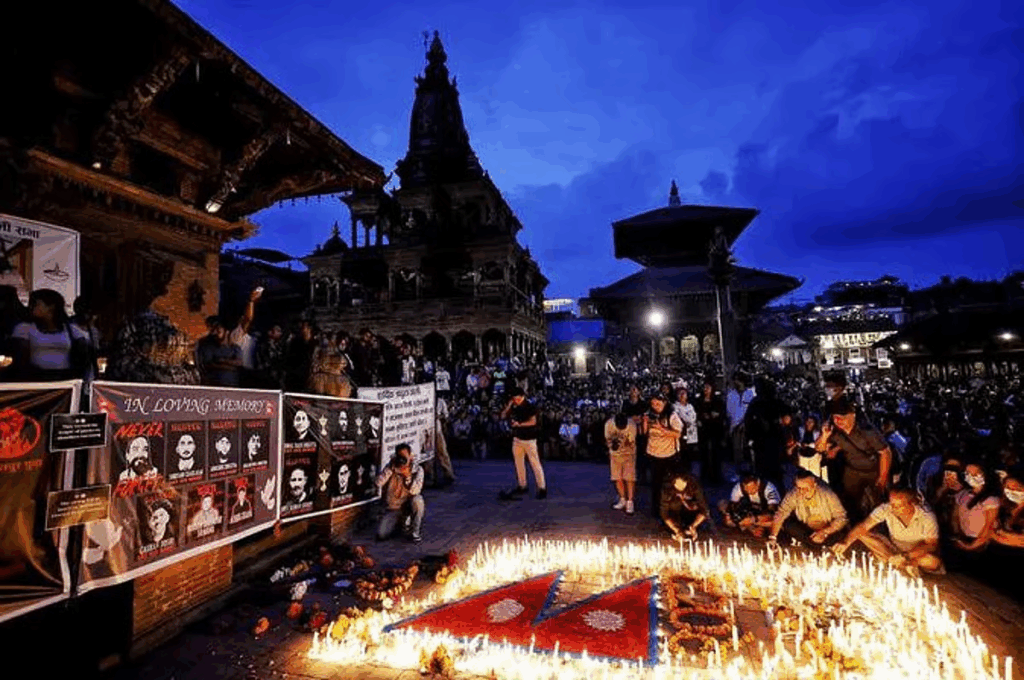
People paying homage to those who were killed in Nepal protests in September 2025. Photo/nepalitimes.com

Sushila Karki sworn-in as interim Prime Minister of Nepal wears a crown of thorns. Tasked to hold parliamentary elections within a period of six months, her initial steps are in the right direction. Good cabinet choices, the announcement of reparation, and the announcement of investigation into the killings of protesters.

A former Chief Justice of Nepal for just a year, she has rich legal experience. While being non-partisan for over three decades, she understands Nepal’s politics unlike most judges of superior courts in many common law countries, including India.

She is incorruptible and a strong-willed individual. The second attribute in the nebulous situation that is Nepal currently can have both useful and difficult dimensions. Like all democracies with weak civilian institutional frameworks, the end game of political control is wily negotiation on a range of issues, most importantly, the loaves of office. Not being part of the gravy train, she will have her task cut out, negotiating with biped bandicoots of all hues.

Public good is the attainment of the holy grail in her case and that of her new cabinet colleagues. Not necessarily shared by those who were shown the door and want it at best to be a revolving door!

Having no cadres of her own, but disparate youth groups, who while being effervescent presently, will in time disappear like the bubbles of protest they created. Some will attempt to create political vehicles of their own while many in due course will become part of the existent political machines they now decry. Others, giving themselves inflated importance, will, to put it mildly, not be helpful.

The duopoly of authoritarians, KP Oli and Sher Bahadur Deuba, both within their respective political machines, had little in common but remaining in office and power. They are out for the count on this round, but the results of the bout are a long way off. The Maoists under Prachanda also want a seat at the high table, though large sections of their cadre seem to have seen through him and his shenanigans. Writing him off would be a mistake. If nothing else, he has immense manipulative skills.

Karki will be expected to show political and administrative results across the board in too many areas in a time frame that will be daunting even for a consummate magician. Even a modicum of administrative reforms to tackle ingrained bureaucratic sloth and petty corruption, which the average citizen faces daily, will be difficult. Having no trained political cadres and without them looking over the shoulders in every one of the 77 Chief District Officer (CDO) offices in Nepal, reform is easier said than done!

The myth of Youth revolution-Pies in the sky!

Too much has been made of the youth revolution. That they were undeniably the catalyst is a no-brainer. They certainly are part of the reformation of Nepal, not the only ones. Widespread alienation of all sections of society from the organs of governance was tinder waiting for a spark.

A reading of the 18th Brumaire is instructive. There are too many parallels between contemporary social discontent and the advent of authoritarian populism in too many countries to ignore.

France 1968 influenced “cultural and political landscapes beyond France. It opened the way for new areas of social emancipation, including feminism, ecology, and gay rights.” As for real political change, c’est la vieThis is how it is.

Lest we forget, massive mobilisation of the youth notwithstanding, the movement failed to overthrow the government or enact a transformation of society. President Charles de Gaulle dissolved the National Assembly, called for new elections, in which his party won a landslide victory, effectively ending the youth upsurge.

The Arab Spring

This is the best fairy tale that emanated from the region since the genie came out from the lamp. In Tunisia, it is back to being what it does best: being a dictatorship. Apart from its cohabitation with ultra-right-wing Israel, Egypt just made sure its democratically elected leader died in prisonJordan will be Hashemite till they obey the diktat of the Golani brigade. No Zia ul Haq and his Arbid brigade presently to mow down Palestinians. Bahrain is secure as the causeway allows Saudi tanks to crush popular unrest. Libya, Yemen and Syria had consequences for all to see.

South Asia youth ferment and consequences

Bangladesh

FALGOON’ and CHAITRA are good months both in the Bengali and Nepali Calendar to visit either of the countries. The elections in both countries will hopefully have concluded, relatively peaceful.

Short of divine or other intervention, the Bangladesh Nationalist Party (BNP) and the Bangladesh Jamaat-e-Islami will be the main contenders, with the BNP clearly having the edge. The newly created party that represents a major section of the students that propelled the ouster of Sheikh Hasina will at best be the third, as the Awami League is not in the running. And an unreformed notorious Directorate General of Armed Forces Intelligence (DGBFI) waits in the wings, its talons sheathed for the moment.

Sri Lanka

The JVP has been the best-organized political party in Sri Lanka. It is no surprise that they rode the Aragalaya protests to electoral success. The creation of the National Peoples Power coalition was nothing short of genius. The Colombo elite personified by Ranil Wickremasinghe were shown the door. Anura Dissanayake has been cautious and astute so far in both domestic and regional politics. His only Achilles heel is the issues relating to the 13th amendment to the Sri Lankan constitution. But that is some way off as there is no overarching leadership in the Sri Lankan Tamil community. It is perhaps the only movement in this part of the globe recently that peacefully toppled the old, ossified elite and carpetbaggers of the clan, Rajapakse.

The choices in Nepal

The Hindutva crowd and Monarchists

They feed on each other just as mice in their filial cannibalism. Their support is presently marginal. Like the Tamil Hindu in India, the average Hindu Nepali can be observant to a fault but is not willing to exchange his or her hard-won democratic freedoms to saffron mendicants who promise them moksha or nirvana in only the afterlife.

It is the abject failure of the parties of the left and the secular Nepali Congress that has given space to those who have little respect for Nepal’s sovereignty. While the wannabe monarch, the beneficiary of a familicide that has yet to see proper investigation, certainly has the capacity to create mayhem. Not only was the lumpen able to storm Nakhu jail and free pro-royalists, but much of the burning and looting, not surprisingly, did not touch the palatial properties of the erstwhile royalty and its courtiers.

The good Nepali Hindu should realise that an embrace of Hindutva brings in its wake the tentacles of Akhand Hindutva India. A pipe dream of the saffron brigade which wants all the present SAARC countries with the exception of Afghanistan but the inclusion of Myanmar in their mythical Aryavart.

The CPN (UML), the Nepali Congress, the CPN (Maoist) all have gerontocratic leadership, which have clearly learnt nothing, as evidenced by their joint statement lamenting the dissolution of Parliament. Would they have been better off with a Nepali Cromwell yelling, “In the name of God, go“?

All of them have capable midlevel and grassroots leadership. The sooner all of them show greater inner party democracy, the better the prospects for parliamentary democracy in Nepal.

In the wings-India-China-USA

For the conspiracy theorists, it must be a dampener that India, the USA, and China have all recognized the legitimacy of the interim government under Karki. This is not to deny that all of them have been fishing in the Koshi and Gandaki river systems. If all of them let their nets and rods be for a while, it will help the Nepali people reiterate their own agency.

The Europeans and the Scandinavians have also not been innocent bystanders. Their ill-advised support to causes that do not befit a sovereign Nepal is legion. They would all help Nepal if they strengthen delivery mechanisms like the offices of the Chief District Officer, which have little resources, are understaffed and office equipment is better on display in museums.

Civil Society in Nepal, as elsewhere in Asia, needs to remember “beware of Greeks bearing gifts”.

To cite only instance, all the fiercely anticommunist donors have been funders of both the Marxist and Maoist influenced civil society organizations! And of course, the name of the game is “color revolution” for those who don pinko red to crimson red!

And not forget that the Army is nearby in Bhadrakali Marg.

The issues in Nepal are too many to enumerate here. Suffice to say, that the Nepalis did not do too badly without colonial interlopers and can do so again with a sagacious national leadership at all levels.

Nepal’s Political Reality: Sushila Karki’s Daunting Task

Scroll to Top